Introduction to Collections — Why They Matter
Why Do These Three Structures Exist?
Imagine you're building a student enrollment system. You need to store student names, keep them in order (because you process them one by one), and you never want the original list to change during processing. Then you realize you also need to look up a student's grade quickly using their ID as a key—searching through a list one-by-one would be slow.
That's where Python's three fundamental collections come in: lists (ordered, changeable), tuples (ordered, unchangeable), and dictionaries (key-value lookups). They're not three ways to do the same thing—they solve three different problems.
This lesson introduces why these structures exist and when to reach for each one. By the end, you'll understand the big picture before diving into the mechanics.
Concept 1: What Are Collections?
A collection is a container that holds multiple related items organized in a specific way. Think of it like choosing between a filing system for a office:
- Notebook: Write items in order, flip through pages (lists)
- Locked logbook: Write items once, can't erase (tuples)
- Indexed catalog: Look up items by name instantly (dictionaries)
In Python, collections let you group related data so you can work with it together:
Loading Python environment...
Without collections, you'd need separate variables for each item:
Loading Python environment...
Collections keep related data together and enable powerful operations.
💬 AI Colearning Prompt
"Why does Python have three different collection types instead of just one? What problem would you run into if you only had lists?"
This exploration helps you think structurally—you're not memorizing facts, you're understanding design decisions.
Concept 2: Sequences vs Mappings
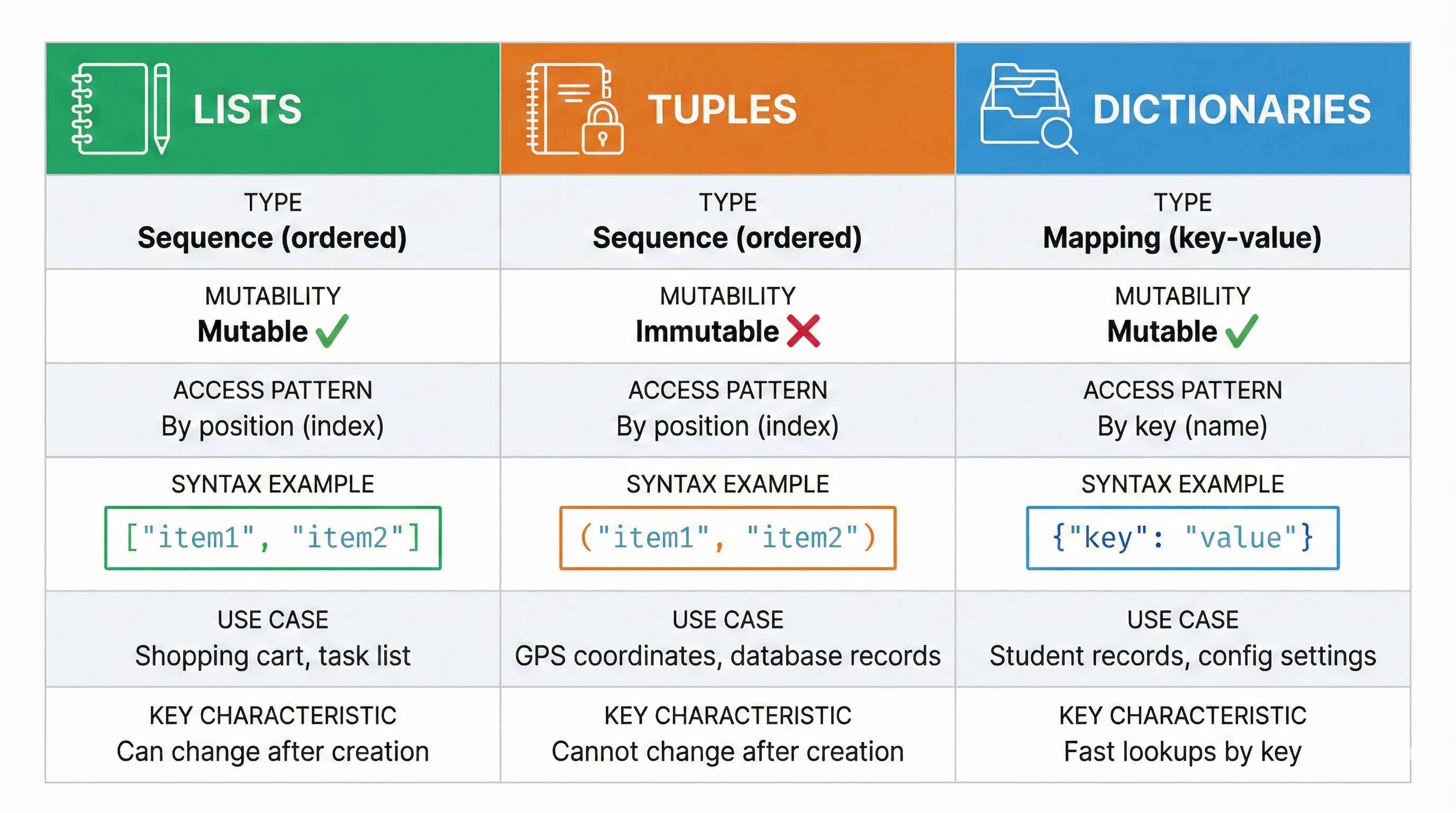
Collections fall into two fundamental categories based on how you access items:
Sequences: Access by Position
Lists and tuples are sequences. You access items by their position (index):
Loading Python environment...
Think of it like a numbered list: you ask for "item #2" and get what's in that position.
Sequences are perfect when:
- Order matters (processing students in enrollment order)
- You want to iterate through all items
- You access by position ("give me the 5th student")
Mappings: Access by Key
Dictionaries are mappings. You access items by a meaningful name (key), not position:
Loading Python environment...
Think of it like a phone book: you don't ask for "person #5", you ask for "Alice's number".
Mappings are perfect when:
- You look up by meaningful identifier (student name, ID, username)
- Order doesn't matter
- You want fast lookups by key ("find this student's grade instantly")
🎓 Expert Insight
In AI-native development, you're not memorizing index numbers or key names. You're understanding the intent: Am I working with ordered items, or am I looking things up by meaningful names? That conceptual difference is what matters. AI will handle syntax; you think about structure.
Concept 3: Mutability vs Immutability
Mutability is whether you can change something after you create it.
Mutable: You Can Change It
Lists are mutable—you can add, remove, or change items:
Loading Python environment...
You start with one list, then change it. The original list evolves.
Immutable: You Cannot Change It
Tuples are immutable—once created, they never change:
Loading Python environment...
If you tried to change a tuple, Python raises an error. Tuples are locked.
Why Does Immutability Matter?
Immutability provides guarantees:
-
Safety: You can't accidentally modify data. Useful for coordinates, RGB colors, or any data you want to protect.
-
Dictionary Keys: Only immutable values can be dict keys. Lists can't be keys (because they change), but tuples can:
Loading Python environment...
- Intent Communication: When you use a tuple, you're saying "this data shouldn't change". When you use a list, you're saying "I might modify this".
🚀 CoLearning Challenge
Ask your AI Co-Teacher:
"Explain immutability and mutability in simple terms. Then show me a real scenario where immutable data is critical for safety (hint: think about coordinates, prices, or configurations)."
Expected Outcome: You'll understand that immutability isn't a limitation—it's a promise. That promise enables certain operations (like dict keys) and prevents certain mistakes.
Concept 4: Type Hints Express Intent
In AI-native development, you communicate what you're building using type hints. They tell Python (and your AI co-teacher) exactly what kind of data you're working with:
Loading Python environment...
Type hints don't force Python to reject wrong data at runtime—they're documentation plus tooling support. But they're powerful because:
-
You communicate intent clearly: Reading
list[str]tells a reviewer "this is a list of student names, not a mix of strings and numbers". -
Your AI co-teacher understands context: When you ask "Check this code" and include type hints, AI knows exactly what you're trying to build.
-
Tools catch errors: Your editor or a type checker (
mypy) warns you if you try to put a number in alist[str].
Loading Python environment...
Your AI can help: "I see you're trying to add 42 to a list[str]. Did you mean to convert it to a string first?"
✨ Teaching Tip
When writing code for this chapter, always include type hints. They're not optional—they're part of communicating intent. Use modern syntax:
list[T],dict[K, V],tuple[T, ...]—not legacytyping.Listortyping.Dict.
Concept 5: Choosing the Right Structure
Now that you understand the differences, let's look at matching the right structure to the right problem.
Real-World Scenario: Student Enrollment System
Problem: Store student enrollment data for a university.
Question 1: Is the data changeable?
- ✓ Yes—students enroll, drop out, update grades
- → Use mutable structures (lists, dicts)
Question 2: Do you access by position or by key?
- Position: "Give me students in enrollment order" → List
- Key: "Find Alice's grade by student ID" → Dict
Question 3: Is any data inherently immutable?
- Student coordinates (GPS location on campus) → Tuple (doesn't change)
Pattern 1: Shopping Cart (List)
Loading Python environment...
Why list?
- Items are processed in order
- You add/remove items frequently
- Position matters
Pattern 2: Game Coordinates (Tuple)
Loading Python environment...
Why tuple?
- Coordinates don't change during gameplay
- Immutability provides safety
- Can be used as dict keys
Pattern 3: User Profile (Dict)
Loading Python environment...
Why dict?
- You look up by meaningful identifiers (name, ID)
- Order doesn't matter
- Fast lookup (critical for 100,000+ users)
Putting It Together
Here's a complete example using all three structures together:
Loading Python environment...
Notice how each structure serves its purpose:
- List: manages the sequence of students to process
- Tuple: stores the unchanging enrollment date
- Dict: enables fast lookup of student records by ID
🎓 Expert Insight
This is the fundamental insight: collections aren't features to memorize—they're architectural decisions. You're not asking "How do I use a list?" You're asking "What's the best way to organize this data?" The collection type is the answer.
Common Misconceptions
Misconception 1: "Why not just use lists for everything?"
Lists work for everything, but they're inefficient for lookups. Searching through 1,000,000 items for one student is slow. Dicts are built for fast lookup—O(1) instead of O(n). You'll understand performance implications deeper in Lesson 10.
Misconception 2: "Tuples seem useless if I can't change them."
Immutability is a feature, not a bug. It enables safety (protecting critical data) and dict keys. You'll appreciate this in Lesson 6.
Misconception 3: "I need to memorize all three now."
No. You need to understand why they exist and when to choose each. Lessons 2-9 teach the mechanics. Lesson 10 solidifies the decision-making.
Next Steps
You now understand the big picture: why Python has three fundamental collections and when each one shines. The next lessons will teach you how to work with each structure in detail:
- Lessons 2-5: Master lists (creation, access, modification, comprehensions)
- Lesson 6: Master tuples (immutability, unpacking, as dict keys)
- Lessons 7-9: Master dictionaries (creation, CRUD, iteration)
- Lesson 10: Learn to choose the right structure for any problem
Try With AI
Practice choosing the right collection type for real-world requirements.
🔍 Explore Collection Selection:
"Show me RPG game data examples: player stats (health, mana), inventory items in order, fixed spawn coordinates, enemy ID lookups. Explain which collection type (list/tuple/dict) fits each and why."
🎯 Practice Type Decisions:
"Help me design a student roster: 100 students by ID (fast lookup), each has name, grades list, immutable enrollment date. Show type hints and sample data for 3 students."
🧪 Test Conflicting Requirements:
"Identify tradeoffs when requirements conflict: inventory needs ordering AND fast 'contains' checks, config is key-value BUT display order matters. Show two approaches for each."
🚀 Apply to Nested Structures:
"Build a university system: departments contain courses, courses contain students. Design the nested dict structure with proper type hints. Demonstrate lookup, iteration, and modification."