Understanding Metaclasses – The Classes That Create Classes
Why This Matters
Before you go further in Python, you've been writing classes like this:
Loading Python environment...
This is so natural, it feels like the fundamental building block. But have you ever wondered: who creates the class itself? Who runs the code that makes Dog into a class object?
In Python, the answer is: a metaclass. And the default metaclass is type. This lesson reveals that mystery—and shows you that class creation is not magic, it's just normal Python code.
Here's the crucial insight: Once you understand how Python creates classes, you unlock the ability to customize that process. Metaclasses let you intercept class creation and add validation, automatic registration, or behavior that would be impossible with regular code.
This lesson is foundational. You'll learn the mechanism first, then see practical applications in Lesson 2. Many developers skip this material and call it "advanced magic." You won't. You'll understand the machinery, and that knowledge will make framework source code (Django, SQLAlchemy) readable to you.
Core Concept 1: What Is a Metaclass?
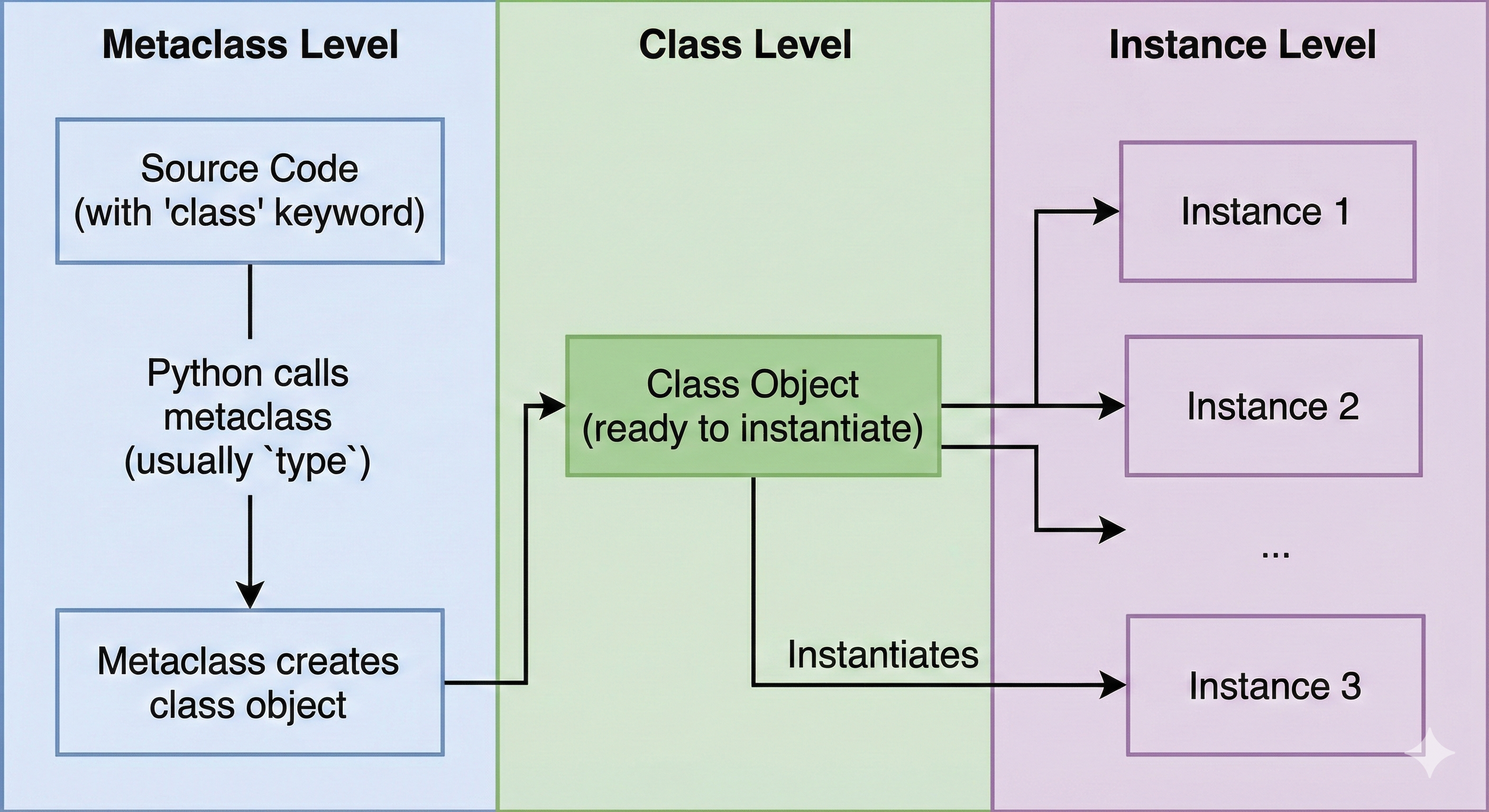
A metaclass is a class whose instances are classes. Think about the hierarchy:
- Object: An instance of class
Dog(a dog instance) - Class: A blueprint (class
Dogitself) - Metaclass: The blueprint that defines how
Dogthe class is created
Every class in Python is an instance of some metaclass. When you write:
Loading Python environment...
Python is actually doing something like:
Loading Python environment...
The default metaclass for all classes is type. Let's prove it:
Loading Python environment...
Notice: type(Dog) returns type, not <class 'Dog'>. The class object itself is an instance of type.
This is the first big insight: In Python, classes are objects too. And the class that creates them is called a metaclass.
Core Concept 2: The type Metaclass
The type metaclass is special. It's the default metaclass for every class you create, and it can also act as a class factory—a function that creates classes dynamically.
When you use type() as a function, the signature is:
Loading Python environment...
Parameters:
name: The class name (string)bases: Tuple of parent classes (e.g.,(object,)or(SomeParent,))namespace: Dictionary of class attributes and methods
Example: Creating a Class Dynamically with type()
Loading Python environment...
Validation Steps:
- ✅ Class creation succeeded without using
classkeyword - ✅ Instance created and methods work
- ✅
type(Dog)confirms it's an instance oftype
This is powerful. It means you can create classes programmatically—at runtime, with dynamic names and methods. This is how frameworks like Django build model classes from database schema.
💬 AI Colearning Prompt
"Why would you ever need to create a class dynamically with
type()instead of just writingclass Dog:? Show me a real-world scenario where dynamic class creation is necessary."
Core Concept 3: How Class Creation Works (The Flow)
When you write:
Loading Python environment...
Python executes this flow:
- Python evaluates the class body (namespace): Code inside the class block runs, populating a namespace dict
type.__new__()is called with (name, bases, namespace): Creates the class objecttype.__init__()is called: Initializes the class object- The class object is returned and assigned to the name
MyClass
This is also what happens when you call type('MyClass', (), {'attr': 42}). The flow is identical.
Why this matters: If you create a custom metaclass (inheriting from type), you can intercept steps 2 and 3. You can inspect the namespace before the class is created, raise errors if validation fails, or automatically register the class somewhere.
Core Concept 4: Custom Metaclass Syntax
To create a custom metaclass, you inherit from type:
Loading Python environment...
Then use it:
Loading Python environment...
Key points:
- Use
metaclass=MyMetasyntax (not inheritance) - The first parameter in
__new__()ismcs(metaclass), notcls - Call
super().__new__()to actually create the class
Example: Basic Custom Metaclass
Loading Python environment...
Validation Steps:
- ✅ Metaclass logs class creation at definition time (not instantiation time)
- ✅ Classes created with metaclass work normally
- ✅ Inheritance chain preserved (Dog inherits from Animal)
Core Concept 5: Metaclass __new__() vs __init__()
A metaclass has two key methods:
__new__(mcs, name, bases, namespace): Creates the class object. It's where you can modify the namespace, raise errors, or build the class conditionally.__init__(cls, name, bases, namespace): Called after the class is created. Use it for post-creation setup (registering the class, initializing class variables, etc.).
Example: Validation Metaclass
Loading Python environment...
Validation Steps:
- ✅ Class with required attribute: created successfully
- ✅ Class without required attribute: raises AttributeError at class definition time (not instantiation)
- ✅ Error message is clear about what's missing
This is your first real metaclass pattern: attribute validation. Lesson 2 builds on this with registration, singleton, and framework patterns.
🎓 Expert Insight
In AI-native development, you don't memorize metaclass syntax patterns—you understand WHEN class creation needs customization. Your job: recognize "this validation must happen before any instance exists" moments. AI handles the metaclass mechanics; you provide the strategic insight.
🤝 Practice Exercise
Ask your AI: "Create a metaclass that ensures all methods in a class have type hints. Then explain why this validation must happen at class creation time instead of at runtime."
Expected Outcome: You'll understand that metaclasses enforce architectural constraints before code even runs, making certain bugs impossible.
Core Concept 6: Understanding Method Resolution Order (MRO) with Metaclasses
When a metaclass is involved, Python follows a specific MRO:
- Check the class itself
- Check the metaclass
- Check parent classes of the metaclass
This matters because if you define a method in a metaclass, you can control behavior across all classes using that metaclass.
Example: Understanding MRO
Loading Python environment...
When you define a method in a metaclass, that method is available on the class, not on instances. This is powerful for adding "class-level APIs" that apply to all classes using the metaclass.
Core Concept 7: When to Use Metaclasses vs When NOT To
This is critical. Metaclasses are powerful but also dangerous (they make code complex). Here's when each is appropriate:
Use metaclasses when you need to:
- Customize how classes are created (validation, registration)
- Implement framework patterns (like Django ORM)
- Enforce class structure across all subclasses
- Automatically collect information from class definitions
Don't use metaclasses when:
- A simple class method or decorator would work
- You need to modify instances (use
__init__()instead) - You want to add behavior to objects (use inheritance or composition)
A common mistake: Using a metaclass to add a method to all instances. That's what class inheritance is for.
Example: Metaclass vs Decorator
Loading Python environment...
Key insight: Choose the simplest approach that solves your problem. Metaclasses are powerful, but decorators, inheritance, and __init__() validation cover most use cases.
Core Concept 8: Real-World Metaclass Preview
Where are metaclasses actually used? In frameworks:
- Django ORM:
Modelmetaclass collects field definitions from class attributes - SQLAlchemy:
DeclarativeMetametaclass builds SQL schemas from Python classes - Pydantic (v1): Metaclass validates data at class definition time
In Lesson 2, you'll implement patterns similar to Django and SQLAlchemy. For now, just know: metaclasses let frameworks turn Python class definitions into database models.
Summary & Key Takeaways
You now understand:
- Metaclasses are classes that create classes — Every Python class is an instance of a metaclass (default:
type) type()is a class factory — Create classes dynamically withtype(name, bases, dict)- Class creation has a flow —
__new__()creates the class object,__init__()initializes it - Custom metaclasses intercept creation — Inherit from
typeand override__new__()to customize - Validation at class creation time — Metaclasses can enforce requirements before a class is usable
- MRO matters with metaclasses — Methods defined in a metaclass become class-level APIs
- Use sparingly — Metaclasses solve framework design problems; most code uses simpler approaches
- Framework patterns ahead — Lesson 2 shows registration, singleton, and framework-like patterns
The big insight: Class creation is not magic. It's just Python code that you can customize.
Part 1: Experience Class Creation by Tracing type()
Your Role: Active experimenter discovering the class creation mechanism with AI collaboration
Before you can understand metaclasses, you need to see that classes are objects like any other. You'll discover Python's type system through AI-guided exploration.
Discovery Exercise: Exploring the Type Hierarchy with AI
💬 AI CoLearning Prompt - Discovering the Type Hierarchy
"I want to understand Python's type system. Help me explore:
- Run
type(42),type("hello"),type([1,2,3])- what do these return?- Now run
type(int),type(str),type(list)- what's different?- Run
type(type)- why does this returntypeitself?- For a custom class I define (
class Dog: pass), what doestype(Dog)return?- Show me a diagram: objects → types → what comes next?
Explain what this reveals about Python's object model."
Expected Understanding: AI will show you that EVERYTHING in Python is an object, including classes themselves. All classes are instances of type, which is the "metaclass" that creates classes. You'll see the hierarchy: instances → classes → type.
💬 AI CoLearning Prompt - Understanding "Everything is an Object"
"You showed me that:
type(42)returnsint(42 is an instance of int)type(int)returnstype(int is an instance of type!)type(type)returnstype(type is an instance of itself)Explain the implications:
- If classes are objects, who creates them?
- What does it mean that
typeis its own type?- Why is this called a 'metaclass'?
- Show me what happens when Python executes
class Dog: pass- what actually runs?"
Expected Understanding: AI will explain that type is the "class of all classes" (a metaclass). When you write class Dog: pass, Python calls type to CREATE the Dog class object. This is the foundation for understanding metaclasses.
💬 AI CoLearning Prompt - Previewing Metaclass Power
"Now that I understand
typecreates classes, show me:
- Can I create a class WITHOUT using
classkeyword? (Usingtype()directly)- What if I want to customize class creation? (Print when classes are made)
- Show me a simple custom metaclass that does something during class creation
- Why would I ever need this in real code?
Give me a concrete example where metaclasses solve a real problem."
Expected Understanding: AI will show you how to create classes dynamically with type(), then introduce a simple custom metaclass. You'll see that metaclasses let you intercept and customize class creation - useful for validation, registration, and framework design.
Part 2: Learn the Metaclass Hierarchy
Your Role: Student learning from AI Teacher
Now that you've observed the pattern, ask AI to teach you the conceptual model.
AI Teaching Prompt
Ask your AI companion (Claude Code, Gemini CLI, or ChatGPT):
"I've discovered that:
type(42)returnsinttype(int)returnstypetype(Dog)returnstype(for any class I define)Explain:
- Why is
typethe type of all classes?- What does it mean for
typeto be its own type:type(type) == type?- Draw a diagram showing this hierarchy: objects → classes → metaclasses
- How does this enable customizing class creation?"
What You'll Learn from AI
Expected AI Response (summary):
typeis a metaclass: It's the factory that creates all classes- Metaclass hierarchy: Every class is an instance of some metaclass; all normal classes use
typeby default - Self-reference:
typeis both a metaclass and an instance of itself (Python's bootstrap) - Customization opportunity: By creating a metaclass (subclass of
type), you can intercept class creation
Convergence Activity
After AI explains, test your understanding by having AI show you code:
Ask AI: "Show me a simple custom metaclass that prints a message whenever a class is created with it. Demonstrate how it differs from a regular class."
Expected AI Response:
Loading Python environment...
Your follow-up: Ask AI to explain WHEN the print statement executes—at class definition time or at instance creation time? Why?
Deliverable
Write 2-paragraph summary in your notes:
- Explain the class hierarchy in your own words (objects → classes → metaclasses)
- Explain what "customizing class creation" means and why you'd want to do it
Part 3: Challenge AI with Edge Cases
Your Role: Student teaching AI by finding boundaries of understanding
Now reverse the roles. You'll ask AI questions that test its understanding of metaclasses and class creation.
Challenge Design Pattern
Create scenarios where AI must:
- Predict what happens at class definition time vs instance creation
- Trace through metaclass calls in order
- Identify differences between regular methods, class methods, and metaclass methods
Challenge 1: When Does Metaclass __new__() Execute?
Your prompt to AI:
"Here's code with a metaclass and two classes:
Loading Python environment...
Without running this code, predict:
- How many times will
__new__be called?- What will the final count be?
- When does it increment (during class definition, instance creation, or both)?"
Expected AI Response:
__new__called 2 times (once for ClassA, once for ClassB)- Final count: 2
- Increments only at class definition time, not at instance creation
Your follow-up: "Now predict what happens if ClassB inherits from ClassA. Will __new__ be called a third time? Why or why not?"
Challenge 2: Metaclass Methods vs Instance Methods
Your prompt to AI:
"In a metaclass, when you define a method, what's the difference between:
Loading Python environment...
Which method gets called by each statement?
MyClass.some_method()obj.some_method()MyMeta.some_method(MyClass)Explain how Python finds the right method in each case."
Expected learning: AI will explain that metaclass methods operate on classes (not instances), while instance methods operate on instances. The method resolution order (MRO) is different.
Challenge 3: Can You Modify a Class After It's Created?
Your prompt to AI:
"Suppose a metaclass's
__new__()modifies the namespace before creating the class:Loading Python environment...
After the class is created, which method name exists:
fetch_data()orFETCH_DATA()? Why?"
Deliverable: In your notes, document three challenging scenarios you posed to AI, record AI's predictions, then verify by running code. Did AI understand metaclass timing correctly?
Part 4: Synthesize Metaclass Understanding with AI
Your Role: Knowledge synthesizer creating reusable mental model with AI collaboration
AI-Assisted Knowledge Synthesis
Instead of manually creating a reference document, work with AI to build a comprehensive mental model of metaclasses.
💬 AI CoLearning Prompt - Building Metaclass Mental Model
"Help me build a complete metaclass understanding reference. Generate:
1. Core Concepts:
- What is a metaclass? (definition + hierarchy diagram)
- How does
typework as the default metaclass?- What's the class creation timeline? (step-by-step)
2. Custom Metaclass Patterns:
- Syntax: How to create and use custom metaclasses
__new__vs__init__: When to use each- Common patterns: logging, validation, registration
3. Decision Framework:
- When to use metaclasses (vs decorators, vs inheritance)
- Trade-offs: power vs complexity
- Real-world examples (Django, SQLAlchemy)
4. Self-Test Questions:
- What is
type(type)? Why?- When does metaclass
__new__()execute?- How is metaclass different from regular class?
Format this as a clear reference guide I can review anytime."
Expected AI Output: Comprehensive metaclass reference with code examples, decision trees, and test questions.
Validation Exercise: Test Your Metaclass Mental Model
After AI generates the reference, validate your understanding with these prompts:
🤝 CoLearning Convergence - Testing Edge Cases
"Test my metaclass understanding with these scenarios:
Scenario 1: I have
class A(metaclass=Meta1)andclass B(A). Does B use Meta1 or type?Scenario 2: If I define a method in a metaclass, can I call it on class instances? Why?
Scenario 3: Can a metaclass modify methods AFTER the class is created? Show example.
For each scenario, explain the reasoning using the class creation timeline."
Expected Outcome: AI will walk you through metaclass inheritance, method resolution, and timing - reinforcing your mental model.
Here's the reference structure AI should generate:
# Metaclass Understanding Reference
*Chapter 31, Lesson 1*

## What is a Metaclass?

A metaclass is a class whose instances are classes.

**Hierarchy** (from simplest to most abstract):
- Object instance: `dog = Dog()` (instance of class Dog)
- Class: `Dog` (instance of metaclass type)
- Metaclass: `type` (the metaclass that creates Dog)

**Visual hierarchy**:
object instance (dog) ──is instance of──> Dog (class) ──is instance of──> type (metaclass)
## The Default Metaclass: `type`

Every class you define uses `type` as its metaclass by default.

```python
class MyClass:
    pass

print(type(MyClass))  # Output: <class 'type'>
This means Python is doing something like:
Loading Python environment...
Custom Metaclasses
To create a custom metaclass:
Loading Python environment...
Key points:
- Inherit from
type - Override
__new__()to customize class creation - Use
metaclass=MyMetasyntax (not inheritance) __new__()first parameter ismcs(metaclass), notcls
Class Creation Timeline
When you write:
Loading Python environment...
Python executes this flow:
- Class body executes: Code inside the class block runs
- Namespace collected:
{'species': 'Canis', 'speak': <function>} type.__new__()called: Creates the class objecttype.__init__()called: Initializes the class- Class assigned to name:
Dog = ...
If a custom metaclass is used, steps 3-4 use your metaclass's methods instead.
Important: Metaclass __new__() runs at CLASS DEFINITION TIME, not instance creation time.
When to Use Metaclasses
Use when you need to:
- Customize how classes are created
- Validate class structure at definition time
- Auto-register classes in a registry
- Implement framework patterns (Django, SQLAlchemy)
- Enforce architectural constraints across all subclasses
Don't use when:
- A decorator would work
- You're modifying instances (use
__init__()) - You're adding methods to instances (use inheritance)
Metaclass vs Decorator: Quick Decision Guide
Metaclass: Works at class definition time, shapes the class itself Decorator: Works on the class after it's created, can modify the class
Usually decorators are simpler and more readable. Use metaclasses when you need to customize the class creation process itself.
Common Metaclass Patterns
Pattern 1: Logging Class Creation
Loading Python environment...
Pattern 2: Validating Required Attributes
Loading Python environment...
Testing Your Understanding
Question 1: What is type(type)?
- Answer:
type(type is an instance of itself)
Question 2: When does metaclass __new__() execute?
- Answer: At class definition time, not instance creation
Question 3: How do you use a custom metaclass?
- Answer:
class ClassName(metaclass=MyMeta):
Question 4: How is a metaclass different from a regular class?
- Answer: A metaclass's instances are classes (not objects); a regular class's instances are objects
### Deliverable

Review the AI-generated reference above and ensure you understand all sections. Save it in your notes for future review. The reference should cover:
1. **What is a metaclass** — Clear definition and hierarchy
2. **The default metaclass** — How `type` works
3. **Creating custom metaclasses** — Syntax and key method (`__new__`)
4. **Class creation timeline** — Step-by-step what happens
5. **Decision guidance** — When to use metaclasses vs alternatives
6. **Common patterns** — 2-3 simple patterns with code
7. **Self-test questions** — 4-5 questions to verify understanding

---

## Try With AI

What happens when you call type(type) and why is type an instance of itself?

**🔍 Explore Class Creation:**
> "Explain the class creation timeline when I define class MyAgent. What happens at definition time vs instantiation? Show when metaclass __new__ executes versus class __init__."

**🎯 Practice Custom Metaclasses:**
> "Create a metaclass that validates all agent classes must define a process() method. Show what error appears if I forget process(). Explain why this catches errors earlier than runtime checks."

**🧪 Test Metaclass Inheritance:**
> "Create BaseAgentMeta that logs creation. If ChatAgent uses BaseAgentMeta and SpecialChatAgent inherits ChatAgent, what gets logged? Walk through the metaclass resolution order."

**🚀 Apply to Framework Design:**
> "Design a metaclass registry pattern where all agent classes auto-register themselves in a global directory when defined. Show how this eliminates manual registration code and enables plugin architectures."

---